Aurora Forecast for Iceland
Northern lights forecast for Iceland built on the NOAA OVATION aurora model, live solar wind from DSCOVR, hourly cloud cover, and the real darkness and moon phase at each location. One score for tonight, an hour-by-hour timeline, and a ranked list of where to go.
Can I see the northern lights in Iceland tonight?
Our aurora forecast gives you a single score out of 100 for tonight, combining the NOAA OVATION aurora model, live solar wind measurements from the DSCOVR satellite, hourly cloud cover, real darkness, and the moon phase. It also ranks dark-sky spots across Iceland so you know where to drive.
When is the best time to see the northern lights in Iceland?
The northern lights are visible in Iceland from late August to mid-April, when nights get properly dark. Peak viewing is October to February, usually between 22:00 and 02:00. From May to July the midnight sun makes aurora impossible no matter how strong the solar activity is.
What does the aurora score mean?
The score is your actual chance of seeing aurora tonight, from 0 to 100. It multiplies four things together: how much aurora activity there is, how dark the sky gets, how much cloud is in the way, and how much moonlight will wash it out. If any one of those is near zero, the score is low — a strong solar storm under thick cloud still means nothing to see.
What Kp index do you need to see the northern lights in Iceland?
Much less than most aurora guides tell you, because those are written for places far south of the auroral oval. Iceland sits underneath it. A Kp of 2 or 3 is a perfectly good night here and will often produce a clear arc across the northern sky, where the same Kp would show nothing at all in the UK or northern Germany. Kp 5 and above is a geomagnetic storm and can fill the whole sky overhead. In practice, on any dark clear night in Iceland it is worth stepping outside to look — cloud cover is a far bigger obstacle than solar activity.
Why does your forecast differ from other northern lights apps?
Most apps show you the Kp index, which is a single global number averaged over three hours and calibrated for latitudes well south of Iceland. We use the NOAA OVATION model, which forecasts where the auroral oval actually sits, and we read it looking north as well as overhead — aurora sits about 100 km up, so an oval over the sea north of Iceland is still clearly visible from the coast. We then multiply that by real darkness at your location, layered cloud cover, and moonlight. That is why our score can be low on a high-Kp night that happens to be overcast, and higher than you would expect on a modest night that is clear and moonless.
Where are the best places to see the northern lights in Iceland?
Anywhere away from town lights with a clear view north. The list below covers twelve spots spread across the country, all reachable by road during aurora season, so that cloud in one region never rules out the whole night. Þingvellir is the closest genuinely dark sky to Reykjavík at about 45 minutes; Mývatn and Ásbyrgi in the north are often clear when the south is shut in; Jökulsárlón adds reflections off the lagoon.
Twelve dark-sky spots across Iceland
Each of these is genuinely dark, reachable by road during aurora season, and far enough from the others that cloud in one region does not rule out the rest of the country. The forecast above scores all twelve against tonight's cloud cover and ranks them.
Þingvellir
The closest genuinely dark sky to Reykjavík — about 45 minutes — with a wide rift valley and lake water to catch the reflection.
Kirkjufell, Snæfellsnes
The mountain in most aurora photographs of Iceland. North-facing coast, a waterfall in the foreground and almost no light pollution.
Vík í Mýrdal
Sea stacks and black sand on the south coast, and one of the more reliably ploughed stretches of ring road in winter.
Kirkjubæjarklaustur
Very dark, on the ring road and open through winter. Fills the long gap between Vík and Jökulsárlón.
Jökulsárlón
Aurora reflected in the lagoon and off the icebergs. Worth the drive when the south-east is the clear side of the country.
Mývatn
Far from any town, high latitude, and geothermal steam that catches the light. Often clear when the south is shut in.
Ásbyrgi
A horseshoe canyon in the far north with sheltering walls — useful on nights when the wind makes standing outside unpleasant.
Egilsstaðir
The east frequently stays clear when weather systems stall over the south and west. Easy road access and a lake nearby.
Ísafjörður
The highest latitude on this list, in fjords with almost no artificial light. Check road conditions before committing in winter.
Hvítserkur
A sea stack on the north coast with a completely unobstructed northern horizon — which is where the aurora usually appears from Iceland.
Reykjanes peninsula
The nearest dark sky to Keflavík airport, so it works on an arrival or departure night when there is no time to go further.
Borgarfjörður
About an hour north of Reykjavík, with valleys that give some shelter from wind and a clear outlook to the north.
Planning a trip? Aurora by month
This page answers "tonight". If you are choosing when to come, each month has its own guide with the actual hours of darkness, road access and an honest verdict.
Northern lights in January · Northern lights in February · Northern lights in March · Northern lights in April · Northern lights in May · Northern lights in June · Northern lights in July · Northern lights in August · Northern lights in September · Northern lights in October · Northern lights in November · Northern lights in December
When and where, from 20 years of data
Which month actually has the most clear dark hours, which places have the most usable sky, and where the solar cycle currently sits — measured, not estimated.
Iceland weather map · Destinations · Northern lights self-drive routes
Stand there now, whatever the sky is doing
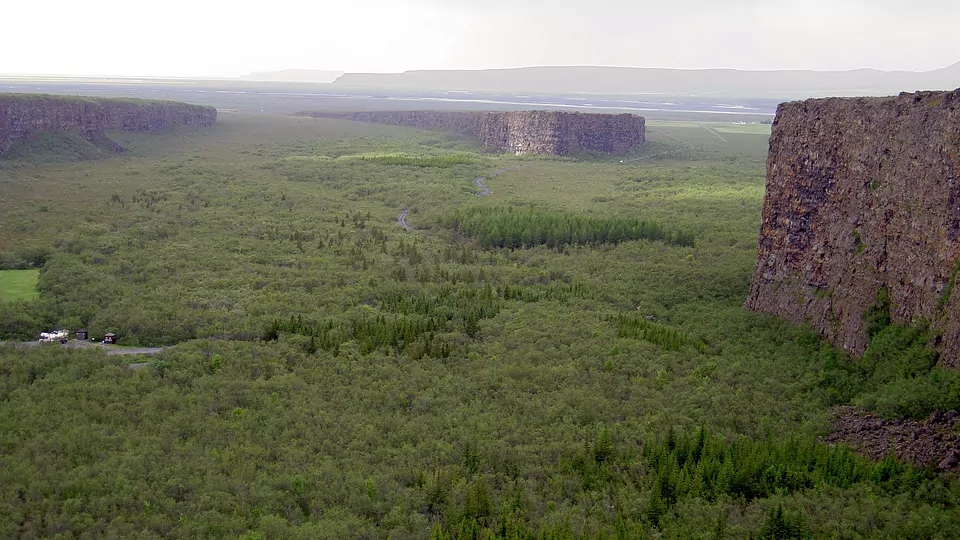
Step inside Asbyrgi — narrated, and dark enough for the lights when the sky clears.